

Areas of Focus
Revolutionary medicines enable us to enrich and extend life for people living with all types of diseases.

Internal Medicine
We’re developing therapies to treat, slow, or prevent disease progression and improve the quality of life for patients with obesity, type 2 diabetes, and cardiovascular and kidney diseases.

Inflammation & Immunology
We look for treatments that provide more than just symptom relief, in order to address the root cause of chronic inflammatory diseases at a molecular level

Vaccines
Vaccines are the single most important innovation in the science of health to significantly reduce the threat of diseases that were once widespread and oftentimes fatal.

Oncology
Cancer treatment needs to be transformed across the entire landscape to significantly improve the lives of cancer patients worldwide.

Highlights
This is our rallying cry as our scientists relentlessly pursue breakthroughs that will change patients’ lives.
2023
Science
Will Win
"There are so many losers. They’re everywhere. Doubt, fear, sorrow. They lose.” This is what happens when science wins."

Clinical Trials
We proudly partner with thousands of study sites and tens of thousands of trial participants around the world. It’s these clinical trials that lead to life-changing medicines.
Go to Pfizer Clinical Trials Site Details
Learn more about the process of joining a clinical trial and find a trial near you.
Diseases & Conditions Index
Explore all of our disease and condition-related resources to learn more about your diagnosis and treatment options.
Search for a Disease or Condition DetailsPartnerships
Fellow organizations actively researching bold scientific ideas, capabilities, and technologies partner with us to bring innovative treatments to patients in need. And we continually seek new partnerships in several key interest areas.
Learn About Our Partners DetailsWe work tirelessly to translate advanced science and technologies into the therapies that matter most.
- Gene Therapy
We’re pioneering breakthroughs in gene therapy to unlock its promise for patients worldwide living with rare genetic diseases for whom the current standard of care falls short. Imagine the possibilities.
- Medicinal Sciences
We’re investing in next-generation science and technology to invent tomorrow’s innovative therapies. The breadth and depth of our colleagues’ technical expertise is second to none, and underpins our groundbreaking approach to the discovery and development of medicines and vaccines
- Precision Medicine
Precision medicine is not only a focus of our R&D strategy, but a philosophy that guides everything we do. New technology platforms enable us to fulfill their potential through cutting-edge applications that better understand the biological basis of a disease.
- Maternal Immunization
Leveraging years of scientific expertise, we’re at the forefront of this field, working tirelessly to discover and develop vaccines that would protect young infants around the world from disease through maternal immunization

Research Sites
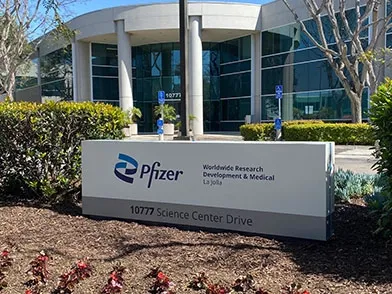
We have Research & Development colleagues across the world to support our product pipeline. Details from major Research & Development locations are listed below














- Pfizer. 2024 Annual Review. Published March 13, 2025.
- The Patients Reached metric is calculated from Pfizer and third-party datasets. Figures may be limited given the coverage provided by external sources (e.g., calendar duration, geographic and product coverage) and are subject to change. Numbers are estimates and, in some cases, use global volume, daily dosage and number of treatment days to facilitate calculations. Methodologies to calculate estimates may vary by product type given the nature of the product and available data. Patients taking multiple Pfizer products may be counted as multiple patients toward the total. Numbers include estimated patient counts from our “Accord for a Healthier World” program. Numbers do not include comprehensive estimated patient counts from Ex-U.S. Patient Support Programs. Historical estimates may periodically be subject to revision due to restatements in the underlying data source.