
What Is Obesity?
Obesity is a common, complex metabolic disease in which fat levels in the body, or the way in which fat is spread around the body, potentially poses a serious risk to health.1 Obesity is a chronic condition, meaning it typically affects people for more than a year and may alter how they live their lives and/or require medical care.1,2
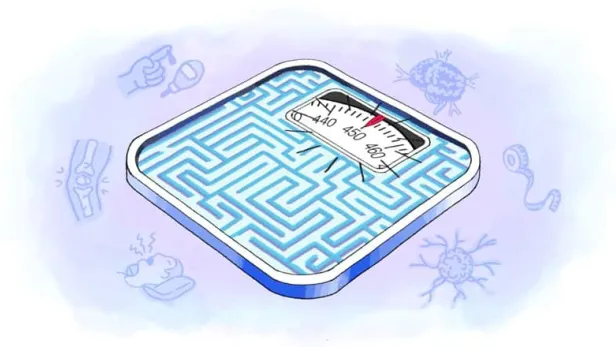
In 2022, six organizations focused on obesity care in the U.S. issued a statement clarifying the definition of obesity. In addition to the buildup of fat that poses a risk to human health, obesity affects nearly all of the body’s life-sustaining systems.1 The condition may increase the likelihood of cancer, cardiometabolic risks, and liver problems. It may also lead to complications such as type 2 diabetes and osteoarthritis.1,2,3
Biologic, genetic, hormonal, and environmental factors all contribute to health issues related to obesity.3 People with obesity also face stigmatization and bias, both of which can block the path to better health and treatment for the chronic condition.1
In 2020, the Centers for Disease Control and Prevention (CDC) estimated that 41.9 percent of adults in the U.S. were obese, based on having a BMI of at 30 kg/m2 or higher, and 9.2 percent of U.S. adults were severely obese, meaning their BMI was 40 or greater.5,6
Prevalence of Obesity
Globally, obesity rates have almost tripled since 1975.9 In 2022, the World Health Organization estimated that more than 890 million adults and about 160 million children worldwide had obesity.9 It’s estimated that having obesity or being overweight contributes to about 3.7 million deaths each year globally.9 From 1990 until 2022, the percentage of adults living with obesity jumped to 16 percent globally, while rates among children and adolescents increased to 8 percent worldwide.10
The World Obesity Federation projects that more than 4 billion people aged five and older will be living with obesity or overweight by 2030.11
Obesity Comorbidities
Obesity can predispose people to certain conditions, known as comorbidities, such as:

- Cardiovascular disease, which include disorders affecting the blood vessels and heart, such as coronary heart disease, congenital heart disease, deep vein thrombosis, and pulmonary embolism, among others12
- Hypertension, also known as high blood pressure, which occurs when arteries carrying blood throughout the body become constricted13
- Osteoarthritis, a condition in which joint tissues deteriorate as we age14
- Obstructive sleep apnea (OSA), airway blockage during sleep that leads to decreased oxygen levels and disrupted sleep15
- Type 2 diabetes, a condition stemming from insulin resistance that leads to high blood sugar16
- Metabolic dysfunction-associated steatotic liver diseases (MASLD), which is an accumulation of fat in the liver that does not stem from consuming alcohol17
- Gout,3 a type of inflammatory arthritis that often occurs in a singular joint, usually the joint of the big toe18
- Disease of the gallbladder,3 which can affect how bile flows through the organ’s bile ducts19
- Coronary artery disease (CAD), the buildup of plaque within the arteries that supply the heart with blood20
- Stroke, which is a blood clot or bleed within the brain21
- Venous thromboembolism, or a blood clot in a vein22
- Dyslipidemia, or issues with the levels of cholesterol and/or triglycerides in the blood23
- Metabolic syndrome, a cluster of conditions that raise the risk of cardiovascular events or chronic conditions24
- Vitamin D deficiency, a condition in which the body doesn’t receive enough Vitamin D and may struggle to absorb calcium25
- Reproductive health issues, which can affect reproductive organs and glands that produce hormones26
Obesity can also increase a person’s risk for certain types of cancer. One reason may be that extra fat cells lead to inflammation. Higher amounts of inflammation are associated with a higher risk of cancer. Researchers estimate that regardless of diet, 20 percent of cancers have an obesity link, including:3
- Postmenopausal breast cancer
- Colon cancer
- Endometrial cancer
- Kidney Cancer
- Esophageal cancer
Diagnosis and Treatment
Obesity Diagnosis
Healthcare professionals often use body mass index (BMI) to determine the presence of obesity,3,27 but the thinking behind BMI as a definitive measure is changing. According to the American Medical Association, BMI does not provide an accurate gauge of body fat or other factors that may contribute to obesity.4 However, for now, BMI screening tends to be the baseline obesity assessment.3,27
A person’s BMI is their weight in kilograms divided by their height in meters, squared. The Centers for Disease Control and Prevention (CDC) offers an adult BMI calculator.
Any BMI of 30 or greater is considered obesity. The three sub-classes of obesity include:6
- Class 1: BMI ranges from 30 to less than 35
- Class 2: BMI ranges from 35 to less than 40
- Class 3: BMI is 40 or greater (sometimes called “severe” obesity)
Obesity Treatment
Treatment options for obesity fall into several broad categories: diet and exercise, medication, bariatric surgery, and psychological and behavioral modification.3
- Diet and exercise
Treating obesity may require more than diet and exercise alone. For example, if a person were to cut calories and exercise more frequently, this should create a caloric deficit. However, this strategy may not cause weight loss. One reason is that the body may adapt to the new demands and lower energy intake by altering metabolism and/or the hormones it creates.28
A healthy diet benefits everyone, regardless of weight. So does physical activity,3 but lifestyle changes alone may not be enough to sustain weight loss or maintain a healthy body weight.
- Medication
Newer obesity treatments target the central drivers of the disease, which may promote better weight management in the long term. Medications and other interventions may be required to prevent weight regain.3
Medications that healthcare providers typically prescribe to assist with weight management fall into several broad categories.3 They currently include:
- GLP-1 agonists, which help the body produce insulin after eating29
- Opioid antagonists, which block places in the nervous system that respond to opioids, used in combination with an antidepressant30
- Lipase inhibitors, which alter how the body metabolizes fat.31
- Anorectics, which diminish appetite, used in combination with an anticonvulsant, which make a person feel fuller longer32
- Bariatric surgery
You may hear bariatric surgery referred to as weight loss surgery or metabolic surgery. This procedure includes five types, all of which modify the stomach and/or other parts of the gastrointestinal tract to help achieve weight loss.33
- Psychological and behavioral modification
This strategy gives people with obesity small, personalized steps that they can take to reverse the condition. People who use this approach typically experience weight loss that ranges from 3 percent to 5 percent.3 Modalities may include cognitive therapy, goal setting, identifying and eliminating barriers, motivational interviewing, and action planning.34
Frequently Asked Questions About Obesity
- What is the definition of obesity?
Obesity is defined as any body mass index (BMI) of 30 or more. BMI is calculated by taking weight measured in kilograms and dividing it by height squared measured in meters. While BMI remains the primary way healthcare professionals determine the presence of obesity,3,26 the thinking behind this method is evolving. The American Medical Association, for instance, has released a statement indicating that BMI tends to neglect other factors that contribute to obesity and does not accurately measure body fat.4
- What is the BMI threshold for obesity?
BMIs of 30 or more are classified as obesity, broken down into three sub-classifications. Class 1: BMI from 30 to less than 35, Class 2: BMI from 35 to less than 40, and Class 3: BMI is 40 or greater, which is sometimes called “severe” obesity.6
- What is childhood obesity?
Affecting one in five children and adolescents in the U.S., childhood obesity is a complex health problem that can have serious consequences.35 Children are constantly growing, so body mass index (BMI) assessments change based on their age and are assigned into percentiles. Healthy weight is considered 5th to 85th percentile. Overweight is considered 85th to 95th percentile. Obesity is considered 95th percentile and above. Severe is considered 120 percent of the 95th percentile or more.36
- What is the prevalence of obesity in America?
From 2021 to 2023, the prevalence of obesity among adults in the U.S. was 40.3 percent. During the same period, the prevalence of severe obesity was 9.4 percent.37 From 2017 to 2020, 19.7 percent of children and teens between the ages of 2 and 19 had obesity.7
Learn More About Obesity
Find a Pfizer clinical trial for obesity at PfizerClinicalTrials.com.
Explore obesity clinical trials at ClinicalTrials.gov.
Area of Focus: Internal Medicine
Obesity is a focus of Pfizer’s Internal Medicine Therapeutic Area. Visit the Internal Medicine Page.
- References
- Consensus statement on obesity as a disease. The Obesity Society, the Obesity Action Coalition, the Obesity Medicine Association, the American Society for Metabolic and Bariatric Surgery, the Stop Obesity Alliance, and the Academy of Nutrition and Dietetics. https://asmbs.org/resources/consensus-statement-on-obesity-as-a-disease#. December 2022. Accessed June 3, 2026.
- Consequences of obesity. Centers for Disease Control and Prevention. https://www.cdc.gov/obesity/php/about/consequences.html. Updated December 5, 2025. Accessed June 3, 2026.
- Wharton S, Lau DCW, Vallis M, et al. Obesity in adults: a clinical practice guideline. CMAJ. 2020;192(31):E875-E891.
- Berg, S. AMA: Use of BMI alone is an imperfect clinical measure. American Medical Association. https://www.ama-assn.org/delivering-care/public-health/ama-use-bmi-alone-imperfect-clinical-measure. Updated June 14, 2023. Accessed June 3, 2026.
- Adult obesity facts. Centers for Disease Control and Prevention. https://www.cdc.gov/obesity/adult-obesity-facts/index.html. Updated May 14, 2024. Accessed June 3, 2026.
- Defining adult overweight & obesity. Centers for Disease Control and Prevention. https://www.cdc.gov/bmi/adult-calculator/bmi-categories.html?CDC_AAref_Val=https://www.cdc.gov/obesity/basics/adult-defining.html. Updated March 19, 2024. Accessed June 3, 2026.
- Childhood obesity facts. Centers for Disease Control and Prevention. https://www.cdc.gov/obesity/childhood-obesity-facts/childhood-obesity-facts.html?CDC_AAref_Val=https://www.cdc.gov/obesity/data/childhood.html. Updated May 6, 2026. Accessed June 3, 2026.
- Petersen R, Pan L, Blanck H. Racial and ethnic disparities in adult obesity in the United States: CDC’s tracking to inform state and local action. Prev Chronic Dis. 2019;16.
- Obesity and overweight. World Health Organization. https://www.who.int/news-room/fact-sheets/detail/obesity-and-overweight. Updated December 8, 2025. Accessed June 3, 2026.
- Obesity. World Health Organization. https://www.who.int/health-topics/obesity#tab=tab_1. Accessed June 3, 2026.
- World Obesity Atlas 2023. World Obesity Federation. https://s3-eu-west-1.amazonaws.com/wof-files/World_Obesity_Atlas_2023_Report.pdf. Updated March 2023. Accessed June 3, 2026.
- Cardiovascular diseases. World Health Organization. https://www.who.int/news-room/fact-sheets/detail/cardiovascular-diseases-(cvds). Updated July 31, 2025. Accessed June 3, 2026.
- About high blood pressure. Centers for Disease Control and Prevention. https://www.cdc.gov/high-blood-pressure/about/index.html#cdc_disease_basics_symptoms-signs-and-symptoms. Updated January 28, 2026. Accessed June 4, 2026.
- Osteoarthritis. National Institute of Arthritis and Musculoskeletal and Skin Diseases. https://www.niams.nih.gov/health-topics/osteoarthritis. Updated September 2023. Accessed June 3, 2026.
- Type 2 diabetes. Centers for Disease Control and Prevention. https://www.cdc.gov/diabetes/about/about-type-2-diabetes.html. Updated May 15, 2024. Accessed June 4, 2026.
- Chan WK, Chuah KH, Rajaram RB, Lim LL, Ratnasingam J, Vethakkan SR. Metabolic dysfunction-associated steatotic liver disease (Masld): a state-of-the-art review. Journal of Obesity & Metabolic Syndrome. 2023;32(3):197-213.
- Gout. Centers for Disease Control and Prevention. https://www.cdc.gov/arthritis/gout/. Updated January 26, 2024. Accessed June 4, 2026.
- Gallbladder diseases. MedlinePlus. https://medlineplus.gov/gallbladderdiseases.html. Updated November 30, 2025. Accessed June 3, 2026.
- About coronary artery disease (CAD). Centers for Disease Control and Prevention. https://www.cdc.gov/heart-disease/about/coronary-artery-disease.html. Updated May 15, 2024. Accessed June 4, 2026.
- What is a stroke? National Heart, Lung, and Blood Institute. https://www.nhlbi.nih.gov/health/stroke. Updated May 26, 2023. Accessed June 3, 2026.
- What is venous thromboembolism? National heart, Lung, and Blood Institute. https://www.nhlbi.nih.gov/health/venous-thromboembolism. Updated September 19, 2022. Accessed June 3, 2026.
- Pappan N, Rehman A. Dyslipidemia. StatPearls. https://www.ncbi.nlm.nih.gov/books/NBK560891/. Updated March 4, 2024. Accessed June 3, 2026.
- What is metabolic syndrome? National Heart, Lung, and Blood Institute. https://www.nhlbi.nih.gov/health/metabolic-syndrome. Updated May 18, 2022. Accessed June 3, 2026.
- Vitamin D deficiency. MedlinePlus. https://medlineplus.gov/vitaminddeficiency.html. Updated April 22, 2024. Accessed June 3, 2026.
- Silvestris E, de Pergola G, Rosania R, Loverro G. Obesity as disruptor of the female fertility. Reprod Biol Endocrinol. 2018;16(1):22.
- What are overweight and obesity? National Heart, Lung, and Blood Institute. https://www.nhlbi.nih.gov/health/overweight-and-obesity. Updated March 24, 2022. Accessed June 3, 2026.
- Adams J. Addressing socioeconomic inequalities in obesity: Democratising access to resources for achieving and maintaining a healthy weight. PLoS Med. 2020;17(7):e1003243.
- Most J, Redman LM. Impact of calorie restriction on energy metabolism in humans. Experimental Gerontology. 2020;113:110875.
- Collins L, Costello R. Glucagon-like peptide-1 receptor agonists. StatPearls. https://www.ncbi.nlm.nih.gov/books/NBK551568/. Updated January 13, 2023. Accessed August 23, 2023.
- Theriot J, Sabir S, Azadfard M. Opioid antagonists. StatPearls. https://www.ncbi.nlm.nih.gov/books/NBK537079/. Updated February 29, 2024. Accessed June 3, 2026.
- Liu TT, Liu XT, Chen QX, Shi Y. Lipase inhibitors for obesity: A review. Biomedicine & Pharmacotherapy. 2020;128:110314.
- Phentermine and topiramate. MedlinePlus. https://medlineplus.gov/druginfo/meds/a612037.html. Updated May 15, 2026. Accessed June 3, 2026.
- Bariatric surgery procedures. American Society for Metabolic and Bariatric Surgery. https://asmbs.org/patients/bariatric-surgery-procedures. Updated May 2021. Accessed June 3, 2026.
- Vallis TM, Macklin D, Russell-Mayhew S. Canadian Adult Obesity Clinical Practice Guidelines: Effective Psychological and Behavioral Interventions in Obesity Management. Available from: https://obesitycanada.ca/guidelines/behavioural. Accessed June 3, 2026.
- Childhood overweight and obesity. Centers for Disease Control and Prevention. https://www.cdc.gov/obesity/childhood-obesity-facts/childhood-obesity-facts.html. Updated May 6, 2026 Accessed June 3, 2026.
- Child and teen BMI categories. Centers for Disease Control and Prevention. https://www.cdc.gov/bmi/child-teen-calculator/bmi-categories.html. Updated June 28, 2024. Accessed June 4, 2026.
- Obesity and severe obesity prevalence in adults: United States, August 2021-August 2023. Centers for Disease Control and Prevention. https://www.cdc.gov/nchs/products/databriefs/db508.htm. Updated September 2024. Accessed June 3, 2026.
The information contained on this page is provided for your general information only. It is not intended as a substitute for seeking medical advice from a healthcare provider. Pfizer is not in the business of providing medical advice and does not engage in the practice of medicine. Pfizer under no circumstances recommends particular treatments for specific individuals and in all cases recommends consulting a physician or healthcare center before pursuing any course of treatment.
Related Articles