
Articles
Featured Articles
Read our latest stories on the people and scientific innovations making a difference in patients’ lives.

Looking Beyond Weight Loss: The Future of Obesity Care
As the understanding of obesity science evolves, focus is shifting from simply reducing body weight to treating obesity as a complex, chronic disease affecting almost every system of the body. Along with new therapies, a growing understanding of obesity’s biological underpinnings is changing how healthcare professionals think about treatment, long-term health, and the future of personalized care.While traditionally viewed as a matter of personal responsibility, scientists now believe obesity is...

How Pfizer Is Rethinking What’s Possible in Cancer Care
For people living with cancer and those who love them, every moment matters. Cancer remains one of the greatest healthcare challenges of our lifetime, and Pfizer is working with urgency to transform scientific advances into potential life-changing medicines.In a sponsored interview, Jeff Legos, Pfizer’s Chief Oncology Officer, sat down with Jessica Sibley, CEO of TIME, to discuss why this mission is personal for him, the responsibility he feels as Pfizer works toward its ambition of delivering...

Pfizer Learns to Speak AI with Fluency Program
Technology moves fast, and there’s no better example than the rapid growth of artificial intelligence (AI).Here at Pfizer, we have long been focused on making breakthroughs that change patients’ lives. As new technology like AI emerges that can help us pursue our goals, we are committed to learning how best to apply AI to help make those breakthroughs even more quickly and efficiently. CEO Albert Bourla is leading the way with his vision for the future of Pfizer. His goal is to leverage AI...

Rewriting the Obesity Narrative
Over millions of years, humans got remarkably good at storing excess energy as fat. To survive perilous stretches of scarcity and famine, our brains evolved to view calorie-dense foods as highly rewarding, and our biology encourages us to eat as much as possible when we encounter them.Fast forward to the modern world, and those kinds of foods are much more readily available, but our brains’ regulatory mechanisms never caught up.1 What was once an evolutionary advantage now works against us. The...

After Treatment: A Hodgkin Lymphoma Survivor Talks about What Happens in Remission
In 2013, Josh Raub’s life was going according to plan. At 29 years old, he was working at his dream job as a professor and pharmacy specialist at an academic medical center in Detroit. He and his wife had just bought their first home and were talking about starting a family. “It was just this perfect future that we were planning for ourselves,” he says.Then he got sick. It didn’t seem like much at first: a low-grade fever, night sweats, fatigue. He thought it might be the flu. He’d get better...

September Social Media Round-Up—Prostate Cancer Awareness, TIME Executives of the Year, and More
As we enter fall, the days are getting shorter and the nights are getting cooler, but Pfizer’s social media channels are as active as ever.In September, we highlighted Blood and Prostate Cancer Awareness months, shared insights into how Pfizer’s helping combat counterfeit medicines, and released new episodes of “What’s In My Lab.” Meanwhile CEO Albert Bourla met with breast cancer patients and health care workers in Kenya and paid tribute to those we lost on the 25th anniversary of 9/11. Our...
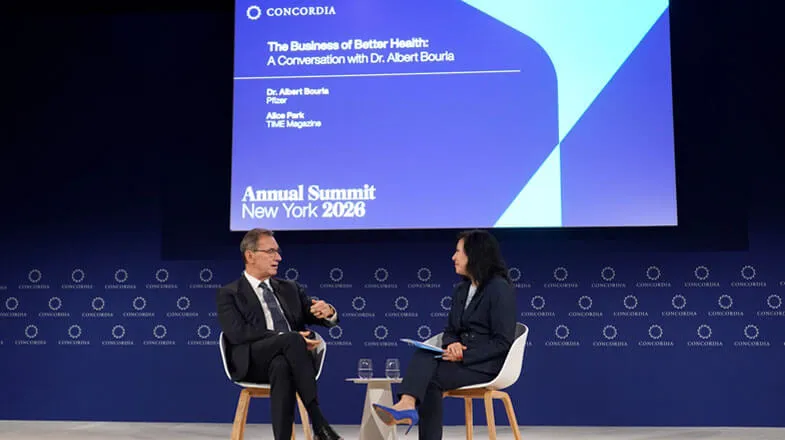
Bourla at Concordia: The Business of Better Health
Each September, government officials, global executives, NGOs and other key leaders converge on New York for the United Nations General Assembly. The week is marked by direct, cross-sector dialogues about the state of the world and how we can plan for a prosperous future.At the 2026 Concordia Annual Summit, Albert Bourla joined that conversation via a mainstage discussion with Alice Park, senior health correspondent at TIME, titled "The Business of Better Health."As the global population ages...

How AI Is Helping Match Patients to Clinical Trials Faster
Long before reaching pharmacy shelves, every new medicine must complete one or more clinical trials. But before researchers can determine whether a potential new treatment is effective, they have to find enough eligible volunteers willing and able to participate in a trial. This process represents one of the biggest challenges in drug development.Patient enrollment is the cornerstone of every clinical trial, but it’s usually the longest phase of the process. Recruiting enough eligible...

Behind the Science: Reprogramming Resistance to Prostate Cancer Treatment
Prostate cancer is one of the most common – and most lethal – cancers in men.1 In the United States alone, nearly 300,000 new cases are diagnosed each year, and it remains the second-leading cause of cancer death among men.2Prostate cancer, in its early stages, is driven by androgens — male hormones such as testosterone – and treatment has the potential to be effective when caught early. Block the androgens, and you can block the fuel the cancer needs to grow.But cancer is adaptive and works to...

Inside Pfizer’s Fight Against Counterfeit Medicine
When Pfizer’s Vice President, Global Security Operations, Angel Melendez raises the issue of counterfeit medicine — deliberately mislabeled to pass off as genuine — he usually gets the same offhand reply: “But it’s not really a problem here in the U.S. though, is it?”Melendez’s response often surprises even seasoned professionals: “Yes, it is.”He recently took part in a panel discussion with top law enforcement executives from across the country. When he discussed the scale and prevalence of...

August Social Media Round-Up—Q2 Results, AI Adoption, and More
Summer is coming to an end, but here at Pfizer, the work doesn’t stop when the seasons change. Before we say goodbye to the warmer weather, let’s take a look back at the month on Pfizer’s social media.In August, we highlighted the importance of our manufacturing systems, leveraged a new AI tool in our supply chain, and released a new episode of "What's In My Lab."Meanwhile, CEO Albert Bourla shared our second quarter results, shared how Pfizer is taking on AI adoption, and sat down with TIME...

A Return to Munich: Reflecting on Eight Years of Progress in ATTR-CM
Eight years ago, few people had heard of transthyretin amyloid cardiomyopathy (ATTR-CM), and it was rarely diagnosed in cardiology practice.1,2 Today, it is a treatable condition that cardiologists and heart failure specialists actively screen for, with dedicated clinics, imaging pathways, and a growing evidence base.ATTR-CM is a rare and underdiagnosed cause of heart failure characterized by the abnormal buildup of misfolded transthyretin (TTR) protein depositing in the heart.1 For years, it...
Media Resources & Contact Information
Anyone may view our press releases, press statements, and press kits. However, to ensure that customers, investors, and others receive the appropriate attention, Pfizer Media Contacts may only respond to calls and emails from professional journalists.