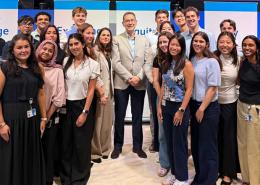
Accelerating Innovation: Pfizer’s 2025 AI Festival
In late October, Pfizer colleagues around the world gathered—virtually and in person—for our second annual AI Festival Week, reaffirming our commitment to innovation and the transformative power of artificial intelligence. This year’s festival was a vibrant showcase of how AI is accelerating progress in science and healthcare, simplifying workflows, and amplifying impact for patients everywhere, at Pfizer and beyond.
With 54 different sessions spanning 7 countries, AI Festival was designed to spark curiosity, foster hands-on learning, and build fluency across Pfizer’s global teams. Through immersive labs, insightful panels, and inspiring keynotes, participants explored the latest breakthroughs in AI, learned practical skills, and connected with thought leaders driving the future of technology.
The week’s collection of working sessions and inspiring presentations was a call to action for every Pfizer colleague to become an AI practitioner and catalyst for creativity, all in the service of our mission of making breakthroughs that change patients’ lives.
The AI Festival began with a Kickoff Session led by Berta Rodriguez Hervas, Pfizer’s Chief AI and Analytics Officer, who set the tone for a week of discovery and engagement, before Pfizer colleagues embarked on a series of Copilot Workshops: Interactive labs on No-Code Agents empowered colleagues to experiment and learn by doing.
One core theme that was reiterated throughout the festival was the idea that high-quality, relevant data is the true driver of AI capabilities. This theme was especially explored during a pair of fireside chats that Lidia Fonseca, Pfizer Chief Digital and Technology Officer, held with two industry leaders.
First up was “AI is a Force Multiplier for Human Ingenuity,” a conversation with Jason Droege, CEO of Scale AI. Lida engaged Jason in a lively discussion about the myriad ways artificial intelligence could both buttress and augment the innovation that human intelligence and creativity already bring to the table. Artificial intelligence is reshaping industries, not by replacing human ingenuity but by multiplying it.
While hardware and models often dominate headlines, the real driver of AI success is high-quality, relevant data. Organizations that prioritize curating, labeling, and updating data will unlock AI’s full potential, enabling systems to remain accurate and adaptable as contexts and regulations evolve. When applied strategically, AI automates repetitive tasks, freeing human talent for creative, high-value work. From streamlining insurance claims to accelerating healthcare workflows, AI is already transforming operations and improving outcomes.
In healthcare and pharma, AI’s impact is profound—speeding up drug discovery, enhancing patient care, and enabling breakthroughs like rapid COVID-19 vaccine development and global-scale manufacturing. Speaking to an audience of engaged colleagues, the message was clear: success with AI requires more than technology; it demands a cultural shift toward experimentation and collaboration.
Rather than replacing jobs, AI creates new roles and elevates existing ones, making curiosity, creativity, and critical thinking essential skills for the future. With human-in-the-loop oversight and alignment, the new technology becomes a trusted partner, paving the way for agentic systems and context-aware applications that drive innovation and deliver real-world value.
Lidia’s second fireside chat focused on the transformative potential of open-source models. Joined by Arthur Mensch, Co-founder and CEO of Mistral AI, this conversation dove into the way these models enable deep customization, secure enterprise deployments, and broader access to information—empowering teams to experiment and innovate without barriers. Integrating proprietary IP and expert feedback into AI workflows accelerates breakthroughs and improves the precision of outputs like clinical trial documentation.
Efficient, smaller AI models are also reducing costs, environmental footprint, and improving user experience. In process-heavy industries, automating complex workflows has resulted in significant time savings—up to 80% in some cases—freeing teams to focus on what matters most.
These fireside chats highlighted how AI is helping organizations move from insight to action, operationalizing high-quality data pipelines, and ensuring accuracy and safety through human-in-the-loop systems—especially vital in healthcare. And the working sessions, where colleagues got a chance to explore the possibilities of adding AI to their daily workflows, offered real-world examples of the way AI is changing the way we work already.
Pfizer understands that adopting AI requires a cultural shift; one that is already underway. Resistance to change is natural, but organizations that embrace change and encourage hands-on experimentation will adapt faster and gain a competitive edge. The festival encouraged colleagues to observe, iterate, and adapt. Building AI literacy across teams and integrating user feedback is key to unlocking the full potential of these technologies.
Pfizer’s AI Festival was not just a celebration of technology, but a testament to our purpose-driven approach: integrating responsible, impactful AI across science and healthcare, for the benefit of patients everywhere. Thank you to all speakers, participants, and partners who made the 2025 AI Festival a resounding success. Together, we are shaping the future and accelerating our journey toward AI-powered impact.