One Pediatric Gastroenterologist’s Mission to Expand Pediatric Treatment Options
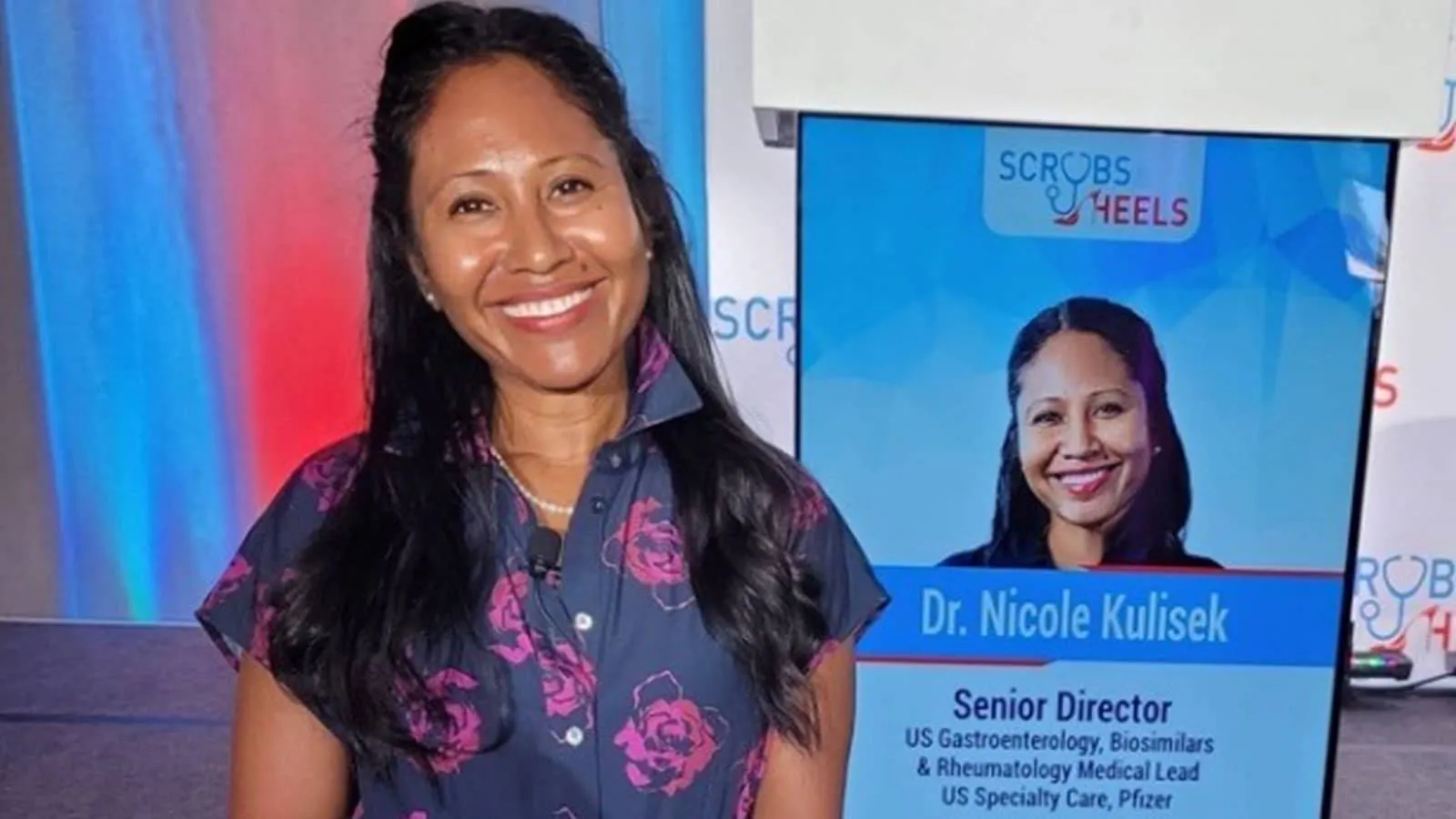
For Dr. Nicole Kulisek, the path from pediatric gastroenterologist to US Medical Affairs leader at Pfizer has always been guided by the same question: How can we expand access to effective treatments for children who need them most?
From bedside care to drug development, her career reflects a belief that early intervention, paired with scientific rigor, can change the course of a child’s life. Today, that perspective shapes her work at Pfizer, where she helps advance IBD innovations aimed at addressing healthcare disparities and the unmet needs of underserved patients, like pediatric patients living with IBD.
Her passion for this belief began as early as her own childhood. Raised in a tight-knit family, she grew up with a connection to medicine shaped by the generations before her.
“I always wanted to be a doctor,” she recalls. “There wasn’t a single moment that decided it. It was just always there.”
That sense of purpose eventually led her to medical school at Boston University, where her professional focus began to take shape. Through the medical center, which was located in an underserved area of Boston, she saw firsthand how social, financial, and educational barriers could influence health outcomes, often long before patients ever entered an exam room.
It was during her pediatric rotation that Dr. Kulisek realized where she could make the greatest impact.
“With children, you can intervene early,” she explains. “You can shape how families think about health, prevention, and care. With adults, habits are often already deeply ingrained. In pediatrics, you still have a chance to change the trajectory.”
Drawn to Pediatrics and Advocacy
That sense of purpose carried Dr. Kulisek into a pediatric residency at Johns Hopkins, a program with an emphasis on health equity that closely aligned with her values.
“I was drawn to caring for children in underserved communities,” she says. “You see how much access — or lack of access — to effective healthcare can shape health outcomes for an entire lifetime.”
One formative moment came early in her residency, when she witnessed the impact of vaccines on pediatric health. During her training, a respiratory syncytial virus (RSV) vaccine became available. Before its introduction, emergency rooms were often overflowing with infants and children struggling to breathe. Almost immediately after the vaccine was implemented, though, hospitalization rates for RSV dropped significantly.
“I was seeing the change in real time,” she says. “It reinforced how powerful medical interventions can be when they’re accessible and widely used.”
Why Pediatric Gastroenterology?
As her medical training progressed, Dr. Kulisek gravitated toward pediatric gastroenterology, a specialty that offered a blend of procedural work, diagnostic complexity, and long-term patient relationships, as well as a culture she found refreshingly collaborative.
“It’s procedure-based, but you’re diagnosing real, symptomatic disease, not screening,” she explains. “And, honestly, GI doctors, and pediatric GI doctors in particular, tend to have a good sense of humor. When you’re dealing with kids and poop and vomit every day, you have to be light-hearted.”
Pediatric gastroenterology also allowed Dr. Kulisek to continue advocating for a patient population that often lacks tailored treatment options. Conditions such as inflammatory bowel disease (IBD) can be devastating for children, affecting growth, development, schooling, and mental health. Yet many therapies are approved only for adults, and pediatric specialists must rely on off label use to help their patients.
“That reality stays with you,” she says. “You’re constantly balancing what you know works with what’s actually approved for kids.”
Shifting to the Pharmaceutical Industry
After years in clinical practice, Dr. Kulisek was faced with a choice. The birth of her son prompted a deeper reflection on sustainability, work-life balance, and how she wanted to contribute to healthcare in the long term.
“I loved my patients,” she says, “but I also knew I needed a model that allowed me to be present as a mother.”
Her transition into the pharmaceutical industry was not entirely unfamiliar territory. Before medical school, she had worked in statistical programming and pharmaceutical research, gaining early exposure to clinical trials and drug development. In 2018, she joined Pfizer in Field Medical.
One defining moment came during her interview process, when she was asked to present data on a drug she’d never used in practice, an advanced oral therapy for ulcerative colitis.
“I was blown away,” she says. “It was the first advanced oral treatment option for ulcerative colitis. Even though it wasn’t approved for pediatrics at the time, I immediately understood how meaningful an oral option could be for my patients.”
As her work at Pfizer continued, Dr. Kulisek’s role evolved from field-based peer education to a leadership position within Medical Affairs. Even though the work differed from her days in clinic, patient impact remained central to her focus.
“In the field, you’re having one-on-one conversations with clinicians,” she explains. “At headquarters, you’re shaping strategy — developing educational resources, working with key opinion leaders, and ensuring that entire communities of providers are informed.”
She also made it a priority to highlight pediatric needs within a space often dominated by adult medicine. Under her leadership, Pfizer convened its first pediatric IBD advisory board and expanded engagement at pediatric gastroenterology conferences.
“Pediatric clinicians treat these diseases, too,” she says. “They deserve to be part of the conversation from the beginning.”
Expanding Options for IBD Patients
Over the course of her career at Pfizer, Dr. Kulisek has worked across multiple therapies within the company’s IBD portfolio. Each represents a different approach to addressing unmet needs, particularly for pediatric patients.
“These treatments aren’t cures,” she emphasizes. “The goal is remission — allowing kids to live normal lives without constant pain, urgency, or fear.”
Navigating regulatory requirements, safety considerations, and clinician education is complex. But for Dr. Kulisek, success always comes back to the same question: Does this help patients who still don’t have enough options?
Advice for the Next Generation
For those considering pediatric gastroenterology or a transition into the pharmaceutical industry, Dr. Kulisek offers candid advice.
“In pediatrics, you’re treating two patients: the child and the parent,” she says. “You need patience, empathy, and resilience.”
And for clinicians entering pharma, humility is key. “You bring disease expertise, but you’re also starting over in a way,” she says. “There’s a whole new language — compliance, regulatory, SOPs — that you have to learn.”
As drug development increasingly includes pediatric trials earlier in the process, Dr. Kulisek hopes the gap between adult and pediatric drug approvals will continue to narrow. For her, the mission remains clear: Advocate for children, address unmet needs, and help advance therapies with the potential to help children worldwide.
“It’s different from helping one patient at a time,” she reflects. “But knowing you’re contributing to something that could help thousands is incredibly fulfilling.”