Bourla at Concordia: The Business of Better Health
Each September, government officials, global executives, NGOs and other key leaders converge on New York for the United Nations General Assembly. The week is marked by direct, cross-sector dialogues about the state of the world and how we can plan for a prosperous future.
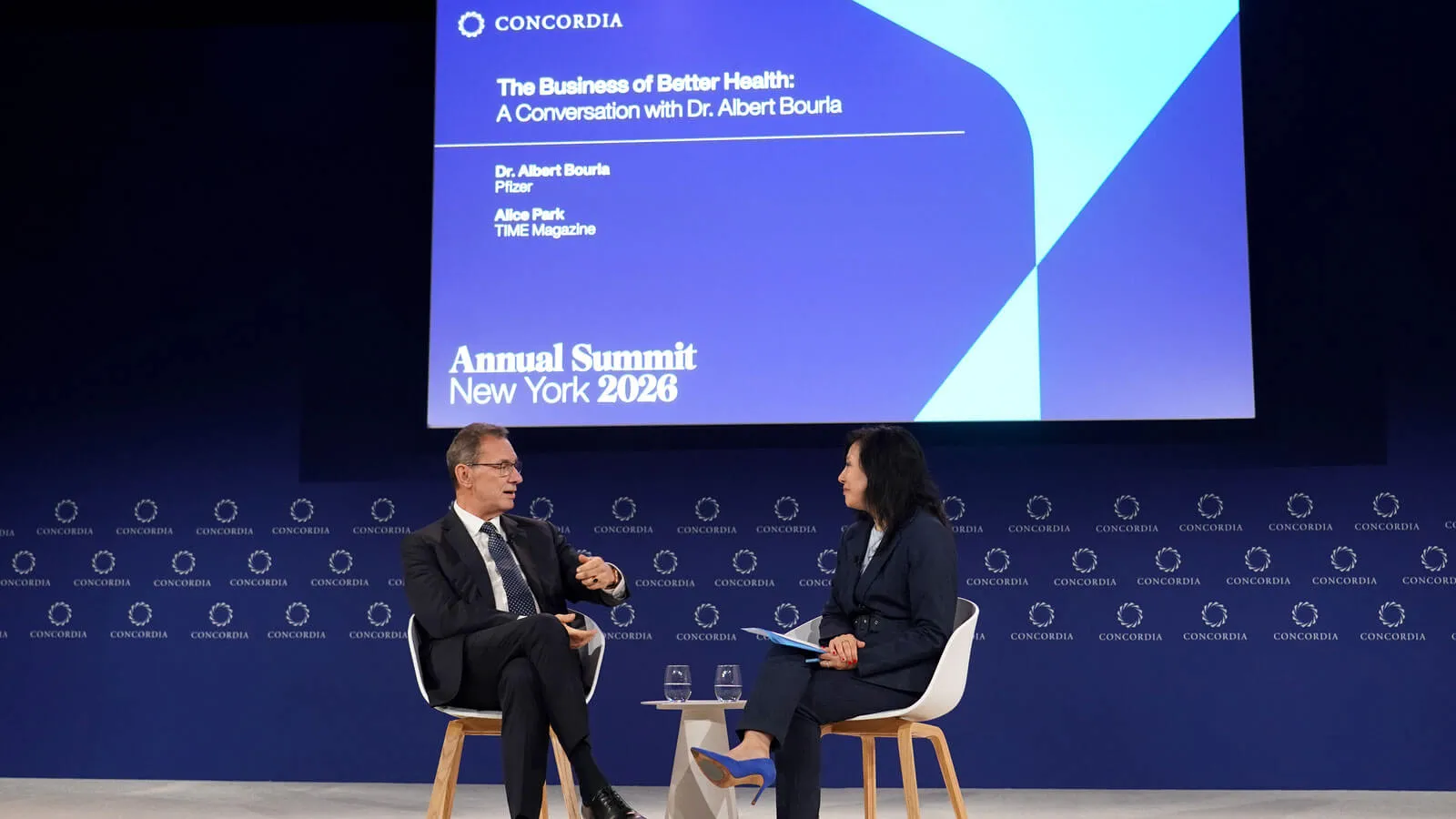
At the 2026 Concordia Annual Summit, Albert Bourla joined that conversation via a mainstage discussion with Alice Park, senior health correspondent at TIME, titled "The Business of Better Health."
As the global population ages, chronic disease is rising faster than health systems were built to absorb. Take cancer: the World Health Organization (WHO) projects cases could climb 67 percent by 2050, and researchers writing in JAMA Oncology put the global economic cost of cancer over the next three decades at $25.2 trillion, driven mostly by productivity lost to early death. Closing that gap means new innovation, stronger health systems, and collaboration that moves faster than the disease burden itself.
Building Resilient Health Systems
“Prevention is one of the most important tools that we have to enhance health.”
Prevention, Bourla said, is the most cost-effective tool available and the one with the widest reach – pointing to how much diseases that used to define entire generations are now just history, thanks to vaccines. Effective prevention keeps people healthier longer, helps ensure a stable workforce, and reduces the burden on strained healthcare systems.
But prevention only works at the scale we need if it reaches those most impacted by disease. Today, people in lower income countries carry 70 percent of the world’s disease burden but receive only 15 percent of global health spending.
An Accord for a Healthier World
Since launching the first-of-its-kind Accord for a Healthier World program in 2022, Pfizer has struck framework agreements with 20 lower-income countries, delivering more than 70 medicines and vaccines on a not-for-profit basis.
The commitment doesn't stop at shipping product where its most needed. Alongside governments, national regulatory authorities, and global health partners, Pfizer is working to build more efficient regulatory pathways, stronger supply chain and logistic capabilities, and better-trained health workforces. The strength of this infrastructure determines whether a medicine that reaches a country’s border actually reaches the patients it’s meant to treat.
Focused Scientific Innovation
“Pfizer [focuses]… where our research is targeting based on two fundamental principles. One is, is there a significant unmet medical need… And the second is, is Pfizer well positioned to develop and deliver the solution?”
With disease burden this widespread, Park asked Bourla about how Pfizer decides where to look for cures. Bourla described a disciplined filter: real unmet need, weighed against where Pfizer can actually outperform anyone else – on science, on field force, on execution. That discipline is why the company’s research is focused in four therapeutic areas: Oncology, Internal Medicine, Inflammation & Immunology, and Vaccines.
Time is Life
“In our profession, time is life.”
Bourla and Park discussed the ways that AI will speed the traditional methods of predicting how a compound will behave before it ever reaches a patient. The focus on speed is important to Pfizer, which is always working to make breakthroughs that change patients lives and get those breakthroughs to patients across the world as fast as possible. Bourla highlights the importance of moving quickly when a few months may make the difference between someone being able to attend their child’s wedding or not.
Pfizer is deploying AI across the company with this in mind. Clinical trial teams use AI to activate sites and match patients in hours instead of weeks, manufacturing lines powered by AI that watch production in real time and flag a potential problem before it actually becomes one, and scientists get thousands of hours back to focus on making breakthroughs because AI now handles administrative tasks and paperwork that can be so time-consuming.
Bourla's message was clear: Pfizer is innovating to bring forward the future of medicine. But innovation alone doesn't close the gap — that takes cross-sector collaboration, building long-term solutions that improve health for all. As Bourla put it, in this profession, time is life. There's none to waste.