
Technology Articles
Featured Articles
Read our latest stories on the people and scientific innovations making a difference in patients’ lives.

The Hidden Infrastructure Behind Every Pfizer Medicine
Getting a medication can seem as simple as a trip to the pharmacy. In reality, that moment is the last step in a complex, rigorous, and largely invisible process.Behind every dose, an extraordinarily complex manufacturing operation helps produce medicines consistently, regardless of where they’re made or where they’ll be used. From qualifying raw material suppliers to monitoring production in real time, pharmaceutical manufacturing depends on thousands of coordinated decisions, rigorous...

How Pfizer Thinks About AI
At Pfizer, our ambition is to be the most AI-forward company in our industry, and we are making great progress every day. I spend more time thinking about it than almost anything else because I believe this is an unprecedented opportunity. AI will fundamentally improve how we discover medicines, how we develop and manufacture them and how quickly we reach patients. Very few technologies can change every corner of a business in this way.AI adoption is one thing — nearly every company has done it...
Then vs. Now: Flow Chemistry
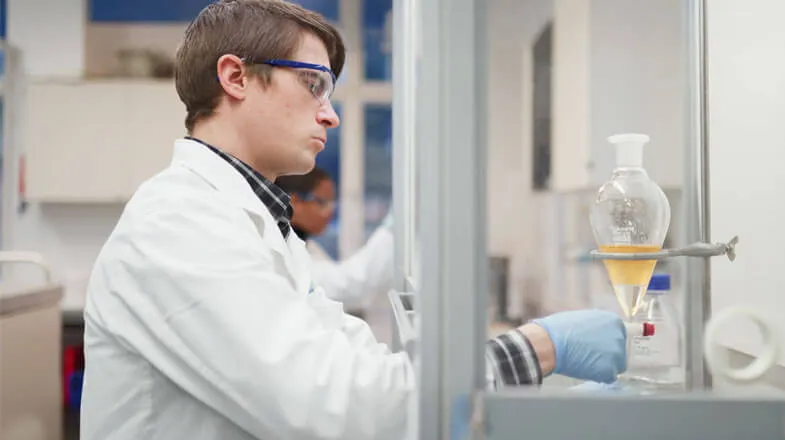
The way medicines are made has changed significantly over time. Many of today’s drug molecules are larger and more complex than those developed decades ago and the methods for synthesis have evolved accordingly. As chemists design increasingly sophisticated molecules, they also need more precise and flexible ways to carry out the reactions that produce them.For much of history, chemists have carried out reactions in static vessels such as flasks in the lab or large reactors in manufacturing...

Then vs. Now: Molecular Design
Developing a new medicine starts at the most fundamental level: understanding how disease works. That often means looking beyond what we can observe directly and studying how molecules interact with biological targets.Much of what drives disease and how we treat it happens at a scale too small to see. In drug discovery, scientists study how molecules find, bind to, and influence their targets. The strength and specificity of these interactions play a critical role in determining how effective a...

Building an AI-Fluent Organization: How Pfizer is helping colleagues understand, embrace, and apply AI
Pfizer has been utilizing artificial intelligence (AI) across our business for some time, but recent advancements in technology combined with advancements in biology are converging to create a scientific renaissance set to transform health as we know it. That reality is already upon us.According to Pfizer CEO Albert Bourla, the biggest barrier to unlock this potential is fear of the unknown. "It is not a question of technology," Bourla said in a recent conversation with Nikolai Tangen of the...
How Biomarker Testing Helped a Lung Cancer Patient Get the Treatment She Needed
Earlier this month, Science Will Win, Pfizer’s award-winning podcast, wrapped up another successful season. Launched in February, season 6 included five episodes, each one focused on a different aspect of the fight against cancer, wrapping with last week’s season finale about AI’s impact on cancer care.All season long, each podcast episode has been accompanied by a full-length video conversation between host Dr. Raven Baxter – a molecular biologist and science educator – and one of her guests...

CEO Albert Bourla Reflects on Pfizer’s Year of Bold Moves and Relentless Innovation in 2025 Annual Review
2025 was a typically busy year for Pfizer, one of strong performance, disciplined execution and bold moves that position us for future growth and lasting impact for patients around the world as we continue to pursue our mission of making breakthroughs that change people’s lives.The entire organization remained focused on addressing the world’s most pressing health challenges, and 2025 was a year of significant progress toward that goal. We’ve detailed some of the highlights in our latest Annual...
The 6th Season of 'Science Will Win' Takes on Cancer
On February 4th, Pfizer observed World Cancer Day, a global effort to raise awareness of cancer and to encourage its prevention, detection, and treatment. We are on a mission to outdo cancer and make 8 breakthroughs in the fight against the disease by 2030.It all starts with education, which is why we’re excited to announce that the new season of our award-winning flagship podcast, Science Will Win, which launched today, is tackling cancer head-on with the help of expert doctors and scientists.N...

Pfizer Enters into Agreement with Walgreens to Help Eligible U.S. Adults Navigate Their Healthcare Journey
Winter is a busy time of year. The one thing you don’t want to let fall by the wayside is your health, especially with colder weather potentially bringing an increase in COVID-19, flu, and other respiratory viruses.For some adults, keeping up with their health, including understanding which vaccinations they may be eligible to receive, may feel like a daunting task. The agreement between Pfizer and Walgreens is intended to help make the process more connected and personal.We recently launched a...

Accelerating Innovation: Pfizer’s 2025 AI Festival
In late October, Pfizer colleagues around the world gathered—virtually and in person—for our second annual AI Festival Week, reaffirming our commitment to innovation and the transformative power of artificial intelligence. This year’s festival was a vibrant showcase of how AI is accelerating progress in science and healthcare, simplifying workflows, and amplifying impact for patients everywhere, at Pfizer and beyond.With 54 different sessions spanning 7 countries, AI Festival was designed...

The Power of Knowing: Medley’s Edith Cooper Talks Equity in AI
Over the summer, Pfizer launched “The Power of Knowing,” a video series hosted by our Chief Digital and Technology Officer, Lidia Fonseca. The series explores how artificial intelligence (AI) is unlocking innovation that was previously out of reach via interviews with industry leaders at the forefront of these changes. Today we’re excited to share a new installment that touches on a topic that’s so important to Pfizer that the concept serves as one of our core values: equity.Equity may not...
Pfizer Racks Up Awards for Podcast, More
Earlier this month, Pfizer released the latest season of our flagship podcast, Science Will Win. Ranking among the top 1% of all podcasts, Science Will Win’s fifth season explores four exciting medical technologies and provides another collection of informative, provocative content around science and pharma.Award-winning content, as a matter of fact! Today we’re delighted to share some of the accolades that Science Will Win’s fourth season recently received.At the MM+M awards, the medical...
Media Resources & Contact Information
Anyone may view our press releases, press statements, and press kits. However, to ensure that customers, investors, and others receive the appropriate attention, Pfizer Media Contacts may only respond to calls and emails from professional journalists.